
A sports article starts with reporting: a checked result, useful observations and people who can explain what happened. The writing gives those facts an order. Your reader should understand the news without having watched the event or read your notes.
For a first assignment, choose a small event you can cover properly. Confirm access with the organizer, agree on the deadline with your editor and find out where official results will be available. A narrow, well-checked report is a better exercise than a broad story built from guesses.
Choose the assignment before collecting notes
A game recap explains a completed event. A preview helps readers understand an upcoming contest. A feature follows a person, issue or development that deserves more space than the result alone. These formats call for different reporting, even when they concern the same team.
For a recap, prepare to verify the result and identify the passage that shaped it. For a preview, check the schedule and availability of relevant participants instead of predicting an outcome as fact. For a feature, write down the central question you need to investigate and the people or records that could answer it.
Ask your editor about length, audience and delivery format. A student newspaper’s brief and a club website’s longer report can use the same verified notes but need different amounts of background. If this is private practice, choose your own reader and state the format at the top of your draft.
Separate checked facts from questions
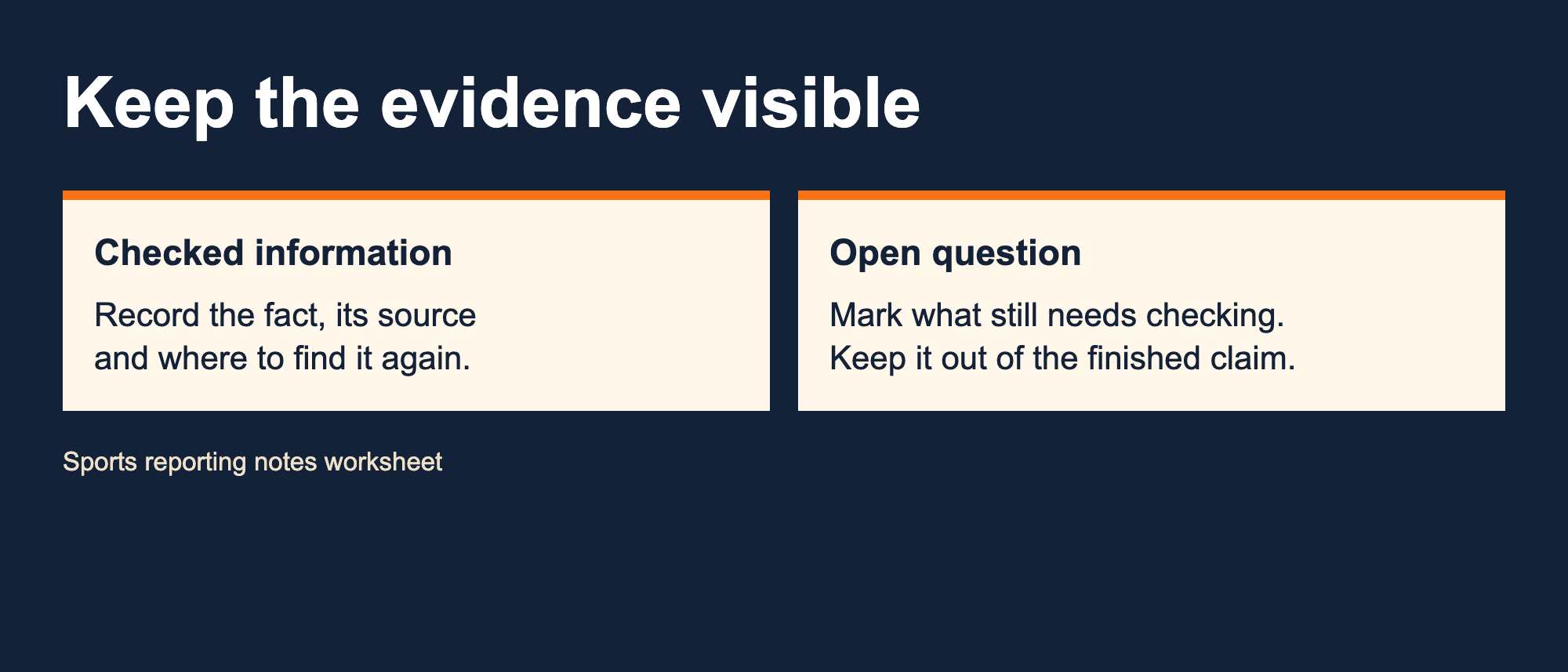
Keep names, results and interview notes easy to trace. Beside a statistic, record where it came from. Beside an observation, note the period or stage of play. Mark anything uncertain with a visible question so it cannot accidentally become a confident sentence.
Reuters’ standards put accuracy ahead of speed. Apply that principle to small details as well as the main result. If your notes and the official result disagree, resolve the difference before filing. Do not choose the number that makes your paragraph sound better.
Make a short reporting list after the event: facts still to confirm, explanations to seek and names to check. This is especially useful before interviews, when the moment you need explained is still clear in your mind. Keep the original notes after writing so an editor’s question does not require reconstructing the whole game.
Give the result a meaningful order
A recap does not need to follow your notebook from the first play to the last. Sports-writing instructor Joe Gisondi recommends giving the result early and supplying context. Choose the most important supported development, then use the surrounding facts to explain it.
In the fictional practice packet below, Westhaven beat Pine Creek 3-2 in a soccer match on Friday. The winning goal came in the final minute. Those details support a direct opening. They do not establish that the losing team was exhausted, that a coach made a mistake or that this was the season’s best match.
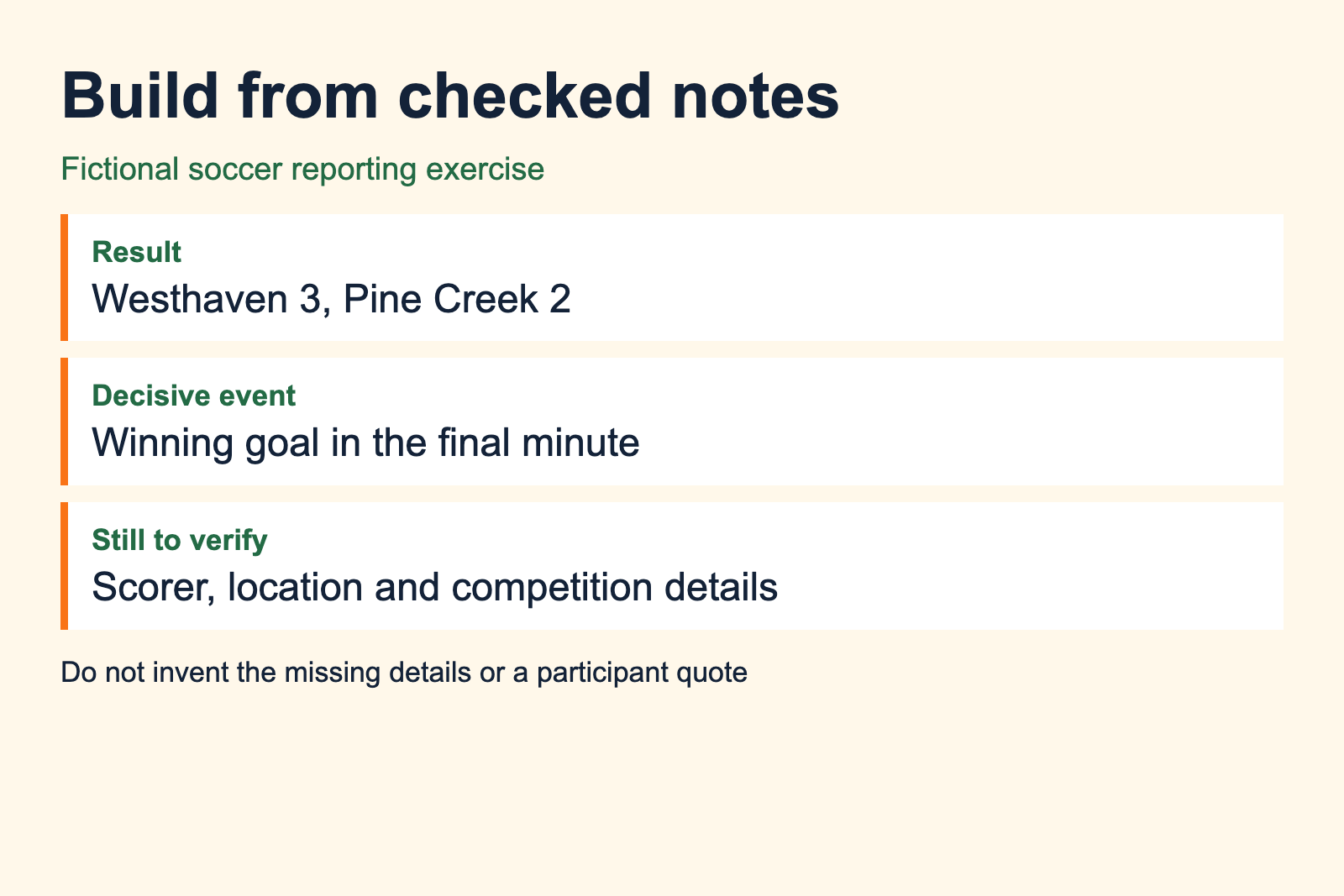
A possible opening is: Westhaven scored in the final minute to beat Pine Creek 3-2 in Friday’s soccer match. This is an invented exercise, not a report of a real event. A real article would also need the checked scorer, location and relevant competition details.
The next paragraph could explain how the goal developed, using your observations and confirmed information. If you did not see the buildup clearly, ask someone who did and attribute their explanation. Do not turn a gap in your notes into a dramatic description.
Use quotations where they add information
A quotation should help readers understand the point beside it. If a player explains a decision during the winning move, place that explanation near your account of the move. Gisondi’s teaching notes caution against collecting unrelated quotes at the end of a game story.
The Associated Press requires accurate, precise quotations. Work from the actual interview material. If your notes do not support someone’s exact words, do not add quotation marks to a reconstructed sentence. Confirm the wording or use a faithful, attributed paraphrase when your notes support that meaning.
A quote does not excuse you from checking the factual claim inside it. A participant can accurately be quoted and still be mistaken about a score or sequence. Check what you can, make the source of an interpretation clear, and seek the relevant response when reporting criticism.
Edit once for meaning and again for details
First read the draft as someone who missed the event. The result, sport and reason the story matters should be clear. Remove repeated information and paragraphs that only retell routine action. Replace unsupported praise or blame with the specific thing you observed or verified.
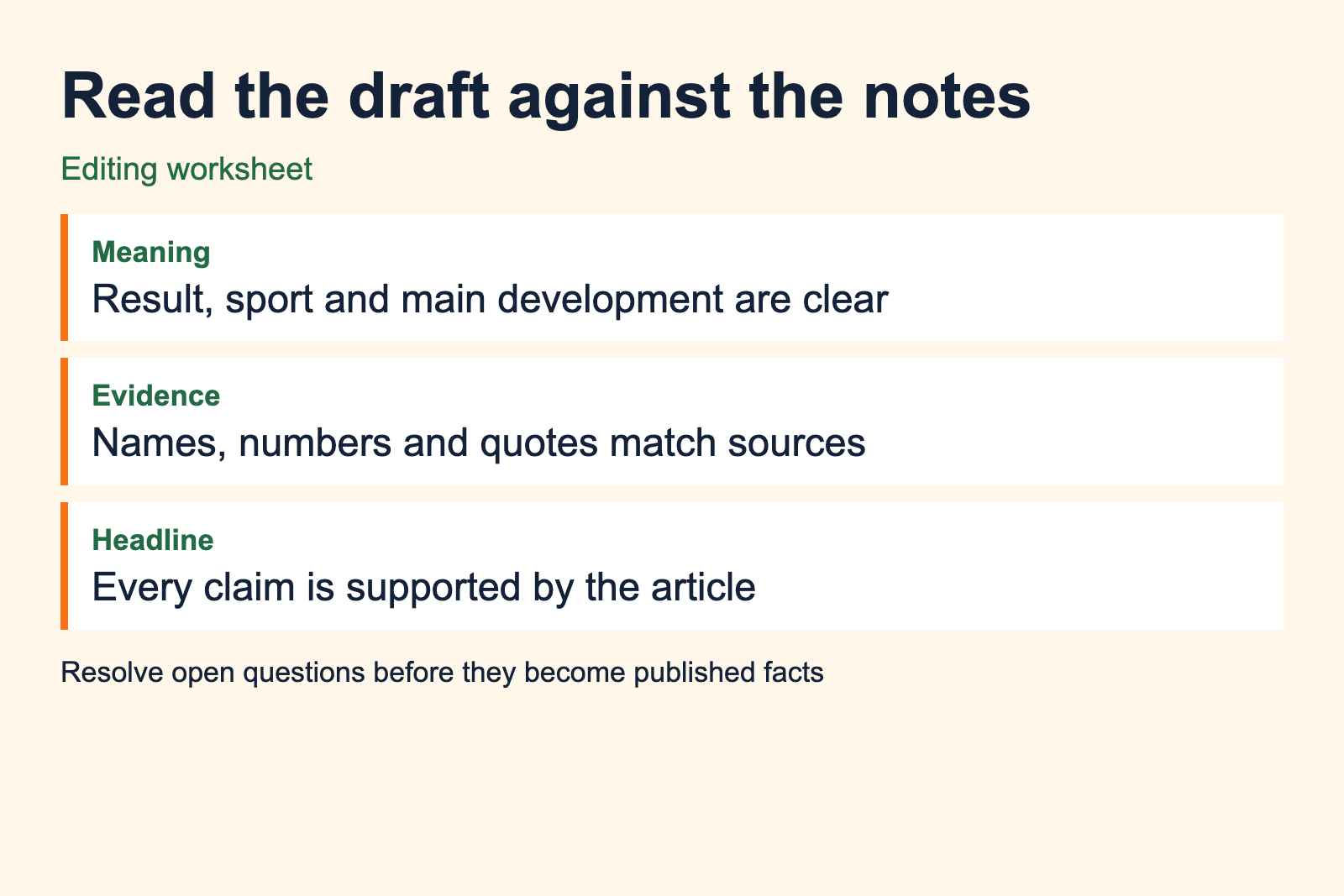
Then compare the draft with your sources. Check every proper name, number, date and quotation. Confirm that a team record is current after the game if you include it. Check a next-game listing against the current schedule rather than copying an old preview.
Read the headline separately. It must make a claim the article supports. A narrow winning margin does not automatically prove a comeback, and a late goal does not mean it was the final play. Keep the headline within the evidence you actually have.
File a clean draft and retain the evidence
Send the article in the requested format with any unresolved questions clearly identified for the editor. Do not hide those questions in polished prose. If an important fact remains uncertain, resolve it, omit it or explain the uncertainty according to the assignment’s needs.
After publication, handle a factual correction visibly under the publisher’s policy. Our editorial standards explain how readers can flag an error here. For your next practice assignment, use the sports writing and reporting guides to work on the reporting skill that gave you the most trouble.
Keep your reporting notes with the finished story. Use the sports media portfolio guide to present the article and explain what you reported yourself.
Sources
- Associated Press, News Values and Principles, accessed September 2026.
- Reuters, Standards and Values, accessed September 2026.
- Joe Gisondi, Sports Media Field Guide, January 2020. Teaching advice for game reports.