
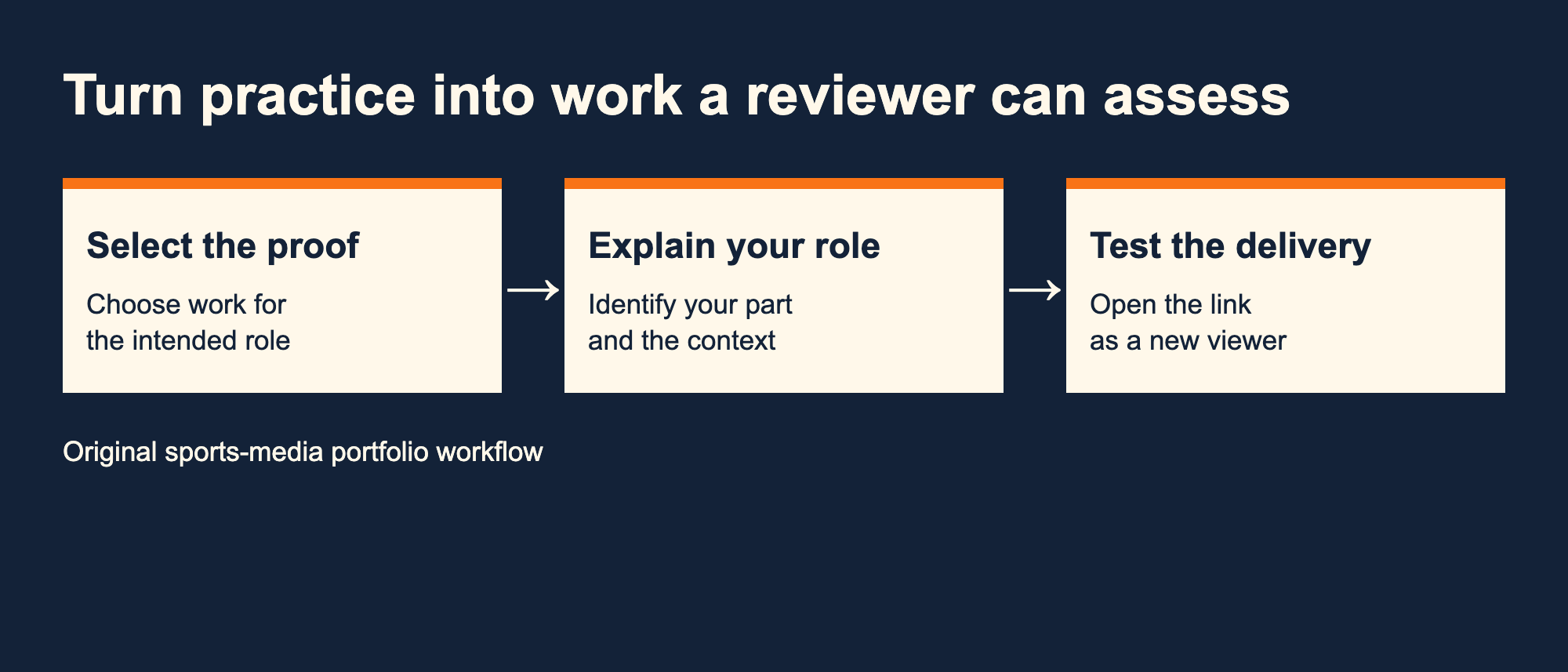
Build a sports media demo reel by selecting work that proves you can do a specific job, explaining your contribution and making the finished samples easy to review. Start with the recipient’s requirements. Then choose the material that answers them.
A sports media reel presents your announcing, reporting, editing or production work. An athlete’s recruiting highlight video serves a different purpose. If you need the latter, use the sports highlight-reel guide. Here, the question is what a reviewer can learn about your work.
Name the role and the evidence it needs
Write the job or opportunity at the top of your working document. Under it, list the skills the reviewer needs to judge. Use the career comparison guide to separate similar-sounding job titles by their actual duties.
A play-by-play sample should let someone hear you explain action. A reporting sample should show what you learned and how clearly you communicated it. A production sample needs an honest account of what you organized, recorded or edited.
STAA’s collected hiring-director advice includes different preferences for demo length. There is no single duration that satisfies every reviewer. Follow a stated requirement; otherwise make the selection purposeful and keep longer work available when it adds useful evidence.
Inventory the work before editing
List your candidate pieces with a date, source file or link, your role and the skill each one shows. Note whether you have permission to share it and whether any facts, names or credits need checking. Keep the original material available while you make the reel.
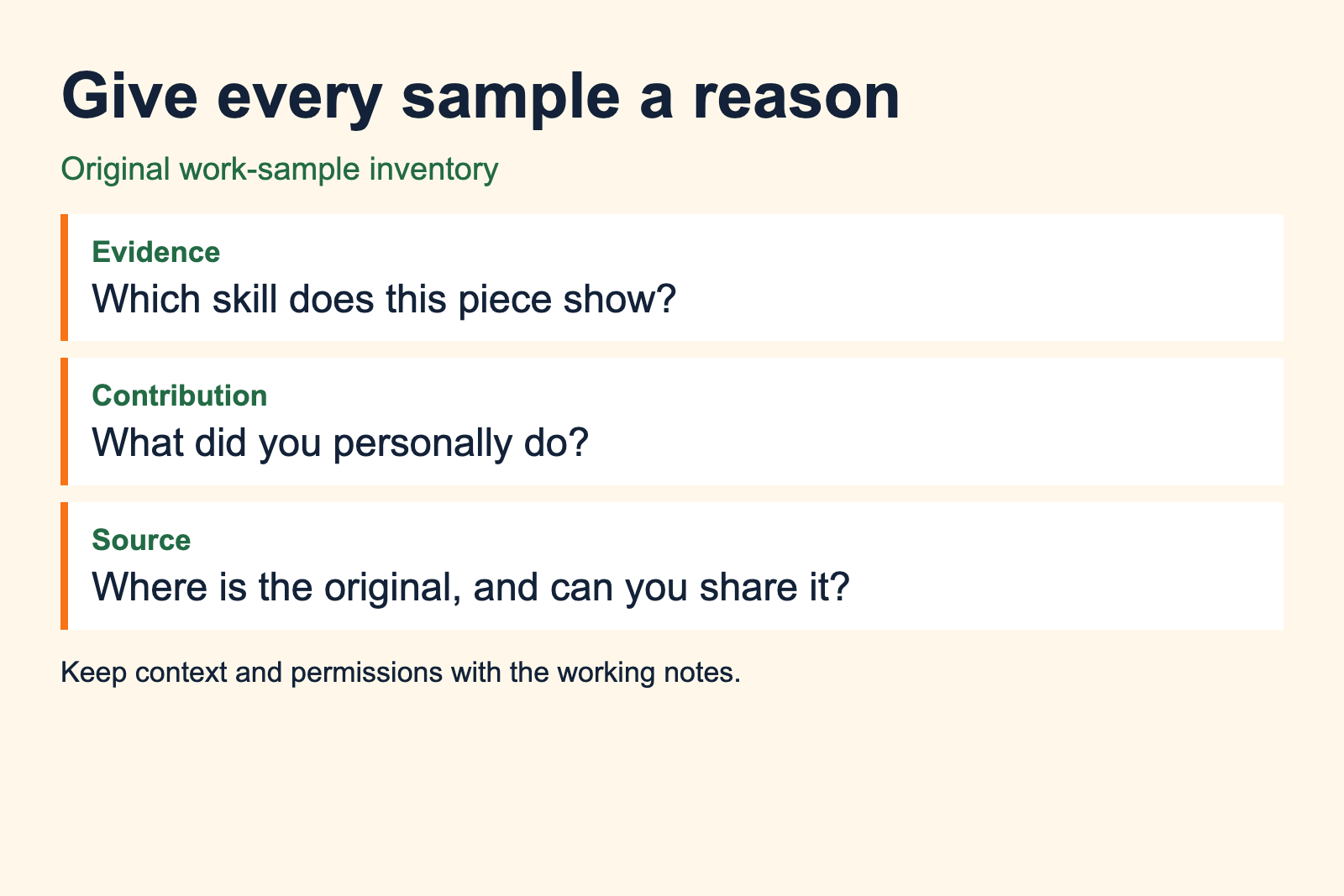
Choose material because it is relevant and strong. Avoid padding the collection with weaker work to reach an arbitrary count. The SIUE portfolio instructions emphasize selection and clear explanations of each contribution. Their course-specific submission requirements are not a universal job-application rule.
For each candidate, write one sentence explaining why it belongs. If several pieces prove the same thing, decide which does it most clearly. Keep another only if it shows a useful difference in setting, responsibility or skill.
Choose sustained work as well as highlights
For an announcing reel, include enough continuous action to reveal your pacing and accuracy. STAA’s examples ask for more than excited scoring calls and include interest in how an announcer works with an analyst. Keep the speech easy to hear rather than covering it with music.
Review your play-by-play against the event itself. If you worked with a partner, use the color commentary guide to assess whether the exchanges add information. Return to the commentary practice exercise when a weak passage needs improvement.
Preparation can support the sample too. Keep your spotter board and, for baseball, your scorekeeping notes so you can explain how you tracked the game. They support the work rather than replacing an audible performance.
Match the format to the skill
A writer’s portfolio should make the article easy to read. Use the sports article workflow to review the central facts and structure, and the journalism guide to check the distinction between reporting and opinion. An interview sample should preserve the meaning of the answers.
For still images, select a coherent set with accurate captions. The photography assignment guide helps you build the source work. Use the camera-settings test and coverage review to identify a technical or storytelling gap before the next event.
For video, keep the complete source from your game recording. For audio production, a focused podcast pilot can show planning and editing. Give it an accurate title using the naming checklist, without making the branding do the work of the sample.
Explain exactly what you contributed
Add a brief project note beside each piece. State what it was made for, when it was made and what you personally did. For a group project, distinguish your work from the other contributors’ work.
An original example might read: practice game recap, recorded in a permitted session; I wrote and voiced the narration and edited the final audio. Use that structure only with facts that are true for your own project. Do not imply that a practice exercise aired professionally.
Describe the recording setup when it helps explain a production responsibility. Avoid a long software list that tells the reviewer little about the finished result.
Export and test the reviewer experience
Export the selected sequence and review the actual delivery file, including the ending. Check sound, picture, names and transitions. Keep a copy of the export that matches the version linked in the application.
Place the reel and supporting samples on a page with clear labels and a short role description. The AP careers page is one example of an employer asking for online work examples and a portfolio link for visual journalists. Always check the current requirements of the opportunity you are pursuing.
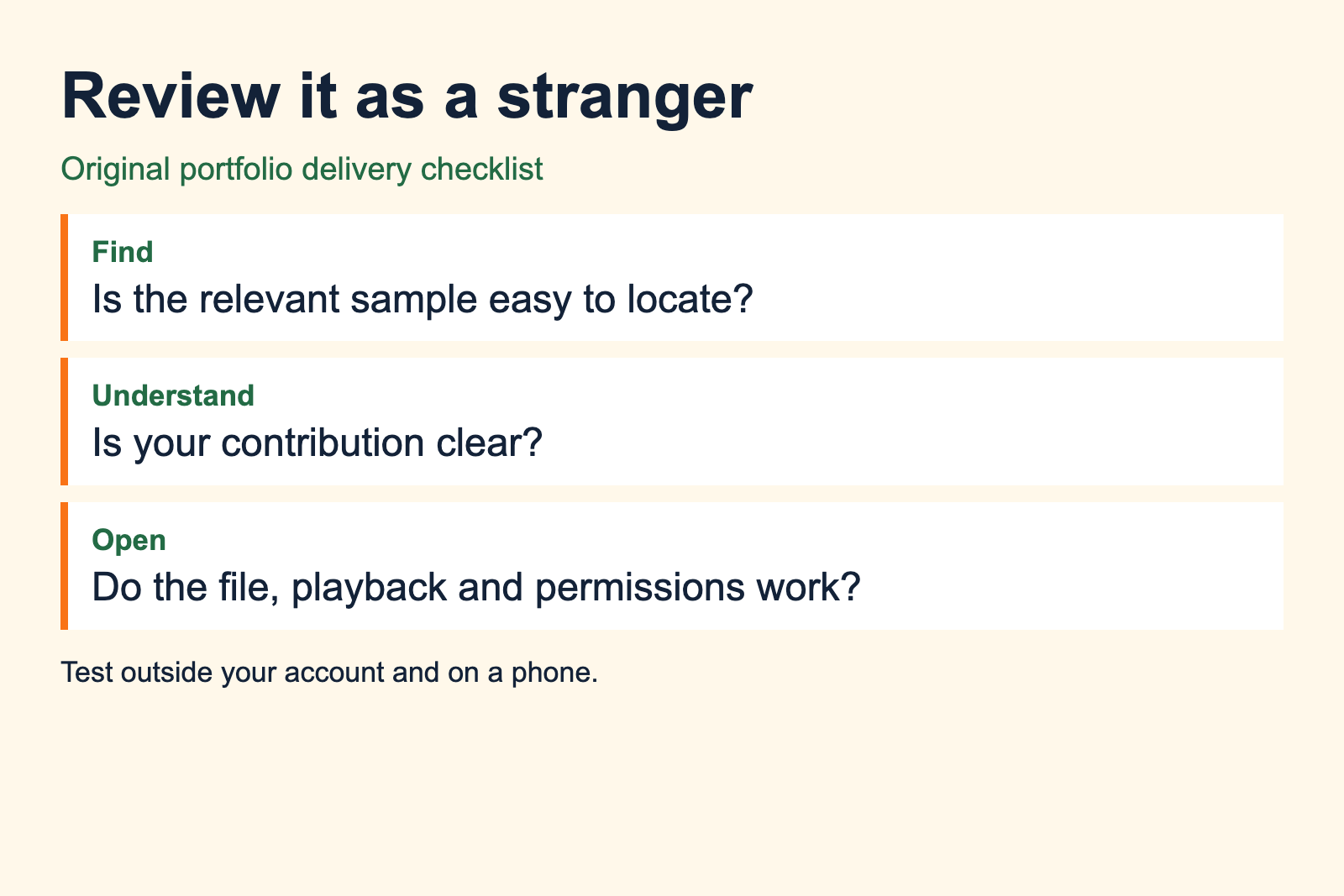
Open the link outside your account and test it on a phone as well as a larger screen. Confirm that files play or open without an unexpected permission request. Ask someone else to find the main sample and tell you what they believe your role was.
Use feedback to choose the next assignment
Ask a reviewer which skill is clear and which still needs evidence. Use the broadcasting career path or reporting career path to choose a realistic project that fills the gap.
Update the portfolio when stronger work is ready. Keep the sample labels, role notes and public links accurate. A reviewer should be able to understand what you did and assess it without needing a separate explanation from you.
Sources
- Jon Chelesnik, STAA, Top Tips on Applying for Big-Time Play-by-Play Jobs.
- Southern Illinois University Edwardsville, Senior Portfolio Instructions and Requirements, stable presentation principles.
- Associated Press, Careers, accessed September 2026. Check current application requirements.