

Color commentary explains the action a sports audience has just watched or heard. The analyst adds a reason, a useful detail or a relevant piece of background while the play-by-play announcer keeps the audience connected to the game. A good first exercise is to explain one visible detail without repeating the call.
You do not need to fill every quiet moment. Start by listening for the question the play leaves behind. A pass reached an open teammate, but where did the space come from? That gives you something specific to examine.
The analyst’s part of the broadcast
In his account of producing Madden commentary, Ernest Adams distinguishes description from added information and insight. His subject is recorded video-game dialogue, but the role distinction is useful when listening to live coverage. The play-by-play voice identifies the event. The analyst helps explain it.
The jobs overlap in conversation. An announcer can make an observation, and an analyst can supply a name the announcer missed. Before a practice call, agree on who carries the moving action and who waits for an opening to develop an explanation. Our first play-by-play practice guide covers the description side of that partnership.
Keep your first contribution narrow. If the play involved a defender stepping toward the ball and leaving someone open, explain that movement. A long account of every player’s position can bury the detail you wanted the listener to notice.
An example of useful color commentary
Consider this fictional basketball exchange. It is a writing exercise, not a transcript of a real game.
Play-by-play: “Lee passes to Morgan in the corner. Morgan makes the shot.”
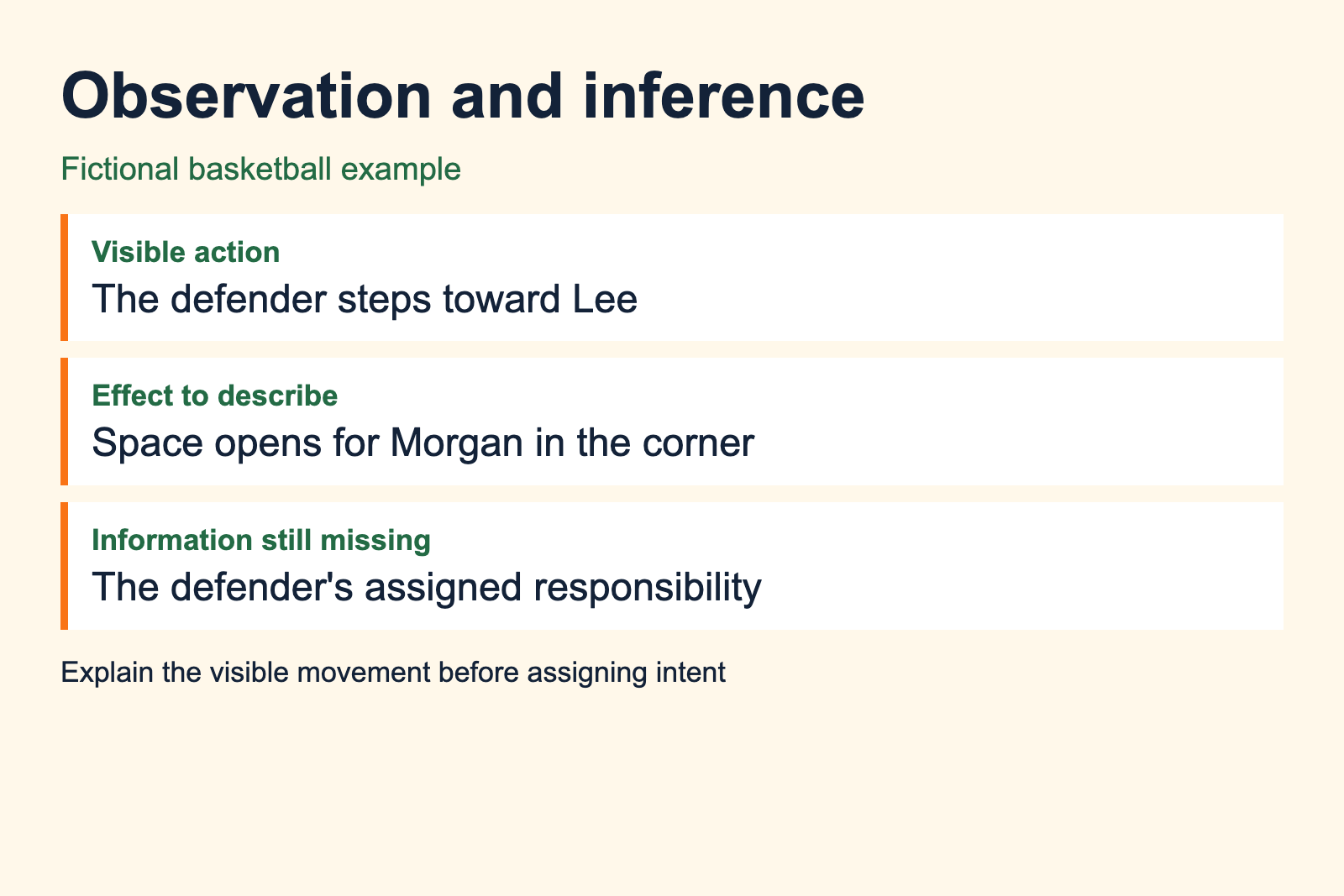
Analyst: “Morgan had room after that defender stepped toward Lee. Watch the space open in the corner.”
The analyst points to a visible cause of the opening. Saying “That was a great shot” would add an opinion without explaining much. Saying the coach called that exact play would introduce information the pictures alone do not establish.
Now shorten the analyst’s line for action that has already restarted: “The defender left Morgan to help on Lee.” You can return to a fuller explanation during a later pause if it still matters. The purpose of this variation is to practice choosing what fits the available opening, not to establish a fixed sentence length.
Observation and inference need different language
Write down what you could point to on a replay. Then write the explanation you think it supports. If the explanation needs knowledge you do not have, change the wording or leave it out. “The defender moved toward the ball” describes an action. “The defender forgot the assignment” claims knowledge of an instruction and a mental mistake.
You can acknowledge a limited view: “From this angle, it looks as though the defender follows Lee.” That is more useful than turning an uncertain impression into a confident statement. If a later angle changes the picture, correct your explanation plainly and continue.
The DC Public Schools radio curriculum puts accurate, fair coverage among the basics of announcing. Apply that standard to background details too. Keep the source beside a statistic or biographical note, check what period it covers, and use it only when it helps explain the game.
For example, an old season total does not describe a player’s current performance. Mark the season in your notes before the number becomes a sentence on air. If you cannot establish its date or source, choose an observation you can support.
Prepare handoffs with your partner
Broadcaster Alex Rawnsley recommends coordinating preparation and agreeing on a format when working with an analyst. His account also describes discussing cues and the openings in which the analyst will speak. That conversation can happen before a student practice session too.
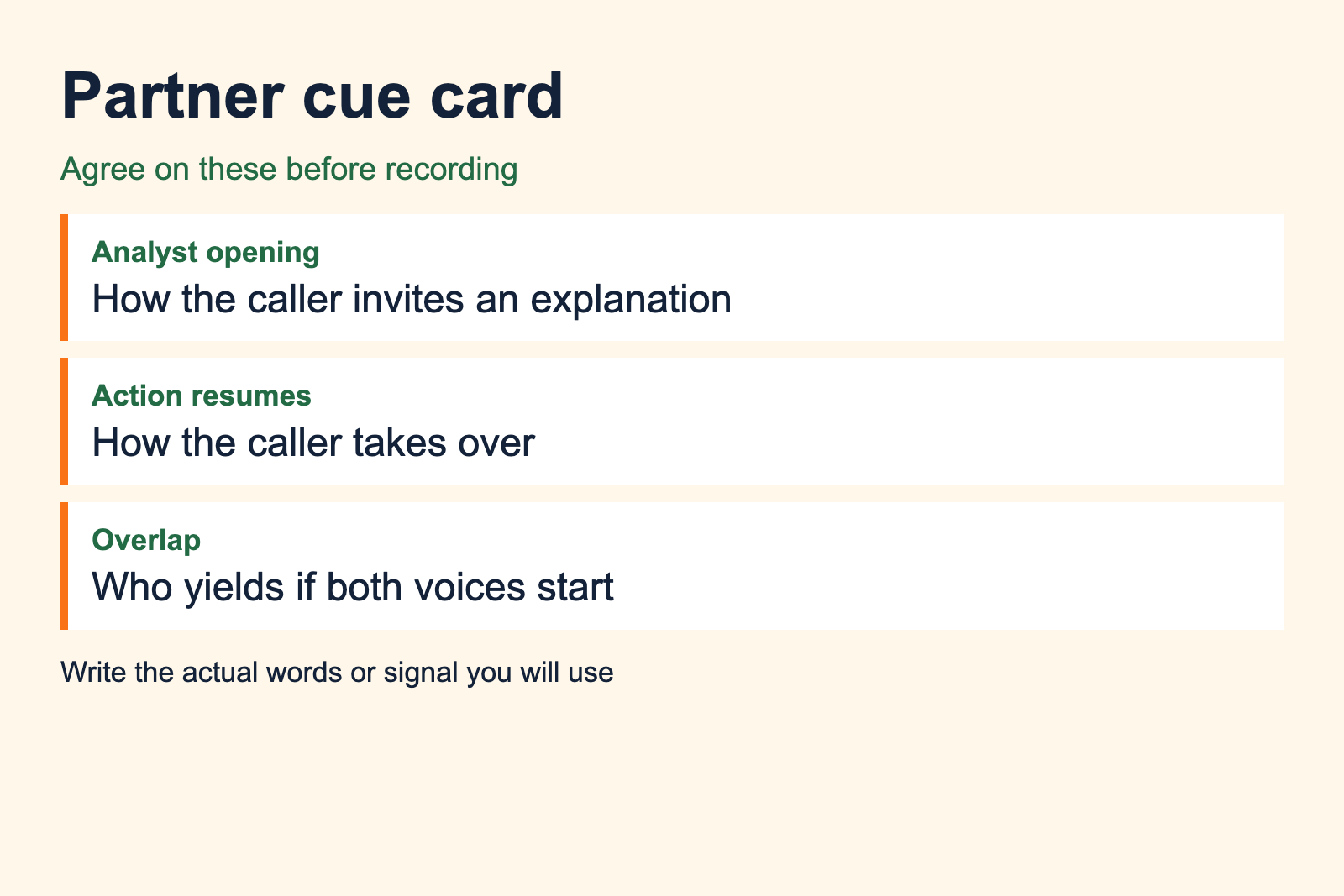
Choose a short stretch of footage you are allowed to use for private practice. Agree on the topics you have checked, who gives the score recap, and how the play-by-play caller will take over when action resumes. Use a spoken cue for a remote practice session, where a glance or a hand signal may be invisible.
If you both begin talking, let one person finish the thought. Discuss the collision afterward and pick a clearer cue. Trying to solve the partnership on the recording can make the audience follow a production conversation instead of the game.
Radio and video leave different gaps
The Southern Utah University sports broadcasting syllabus treats radio and television as distinct forms and asks students to observe both voices. Use that distinction in your own listening. With an audio-only audience, your partner must establish details that a viewer could see.
“Look at that space” needs a location when there is no picture. In the fictional example, you could say, “The corner opened when the defender moved toward Lee near the lane.” On video, you can refer to a replay only when it is actually available to the viewer. Avoid asking the audience to study a picture that has already changed.
A listen-back exercise for two voices
Record a short practice exchange, then listen once for overlap and once for meaning. Put a timestamp beside an analyst sentence that added something useful. Write down the specific detail it added. If you can only say that it sounded enthusiastic, try the line again with a visible observation.
Next, find a sentence that ran into the following play. Record a shorter version, leaving room for your partner to resume. Keep both recordings so you can compare the change. This is an original practice exercise, not a measured training program.
Continue with another exercise from the On-Air and Broadcasting learning track. On the next recording, focus on the one problem you identified rather than trying to change every part of your delivery at once.
Save a passage where your analysis adds useful context to the call. The demo-reel guide explains how to present that passage and identify your contribution.
Sources and further reading
- Ernest Adams on writing sports commentary, September 2009. Used for the role distinction, not live production timing.
- Alex Rawnsley on working with an analyst, accessed September 2026.
- Southern Utah University course syllabus, spring 2026.
- DC Public Schools radio curriculum, historical classroom lesson.