
Keeping score in baseball means recording what happens to each batter and runner, not just writing down the final result. Start with the lineup, choose a clear set of marks and update the runners after every play. A useful scorecard lets you reconstruct the sequence later.
This guide is for a personal practice book. If you have been assigned official scoring duties, use the competition’s current rules and training. A personal notation system does not replace the official record or the separate responsibilities an organizer assigns.
Set up the lineup and inning columns
Write the teams, date and location at the top. Put each batting order in its own section, using the lineup supplied for that game. Leave room for substitutions and enough batting rows for the competition’s format.
Little League’s scorekeeping guide describes the basic grid: batting order down the rows, innings across the columns. The box at their intersection records that player’s turn in that inning. Keep jersey numbers and defensive positions in separate fields.
Before play starts, follow the first few empty boxes with your pencil. Check that you know where the next batter goes and where to record a runner’s later movement. This small rehearsal helps you notice a cramped layout before several events need to be recorded at once.
Learn the defensive position numbers
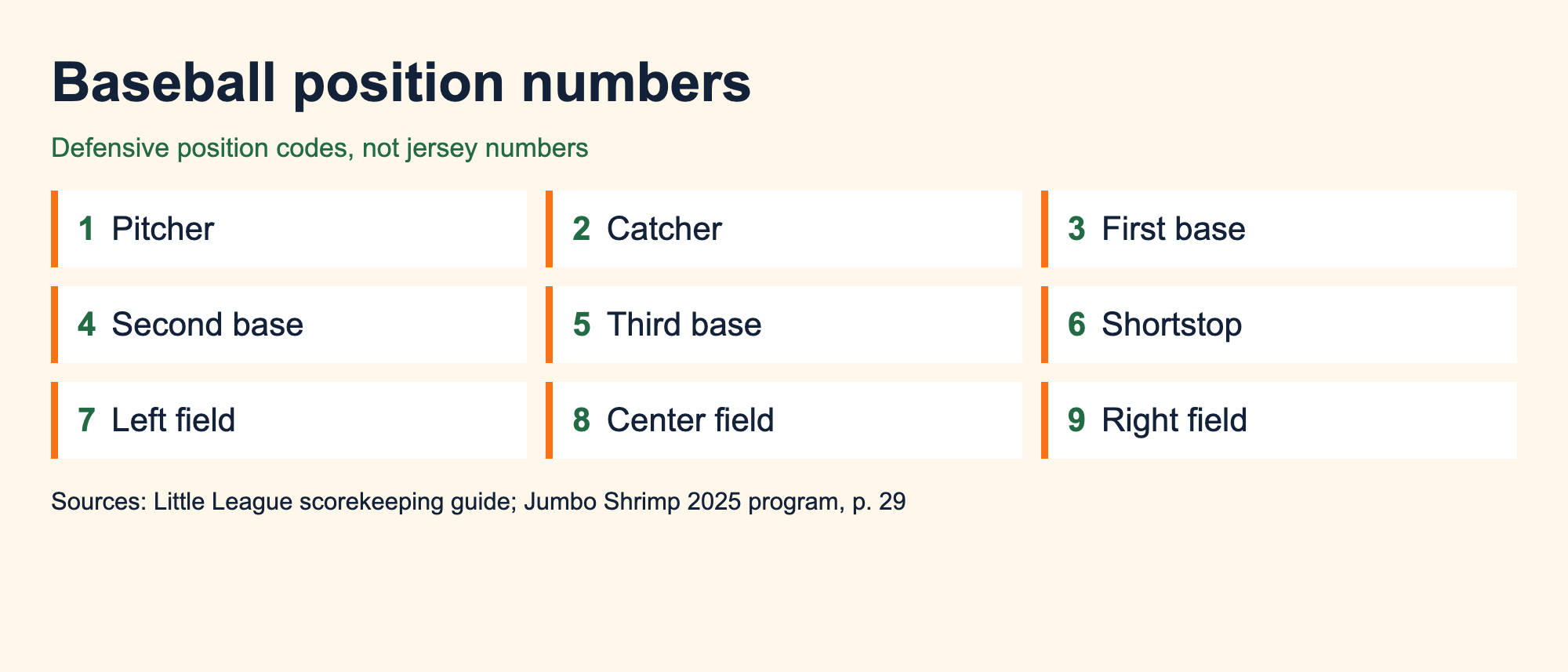
The usual defensive codes run from pitcher at 1 through right fielder at 9. They identify positions, not the numbers on uniforms. The position lookup is cross-checked against Little League’s guide and the Jumbo Shrimp’s 2025 program, page 29.
A groundout written as 6-3 describes the shortstop throwing to the first baseman for the out. It does not mean players wearing those jersey numbers were involved. When a defender changes position, the code follows the position being played.
Choose a small, consistent legend
The Jumbo Shrimp guide acknowledges that fans use different notation. For this exercise, use 1B for a single, 2B for a double, BB for a walk and K for a strikeout. Use P6 for a popup caught by the shortstop. Write that legend where you can see it.
If your scorebook uses a small diamond, trace only the bases the runner actually reaches. Record later advances in that runner’s original box. A batter’s result and a runner’s later movement belong to the same person’s record, even when another player causes the advance.
Do not add every available symbol immediately. First make sure you can follow the batting order, count outs and track runners. Add pitch-by-pitch detail when you can keep it accurately without losing the basic sequence.
Work through a fictional half inning
The following sequence is invented for practice. It starts with empty bases and no outs, and it ends after three outs. The letters identify fictional batters in order. They are not jersey numbers or defensive position codes.
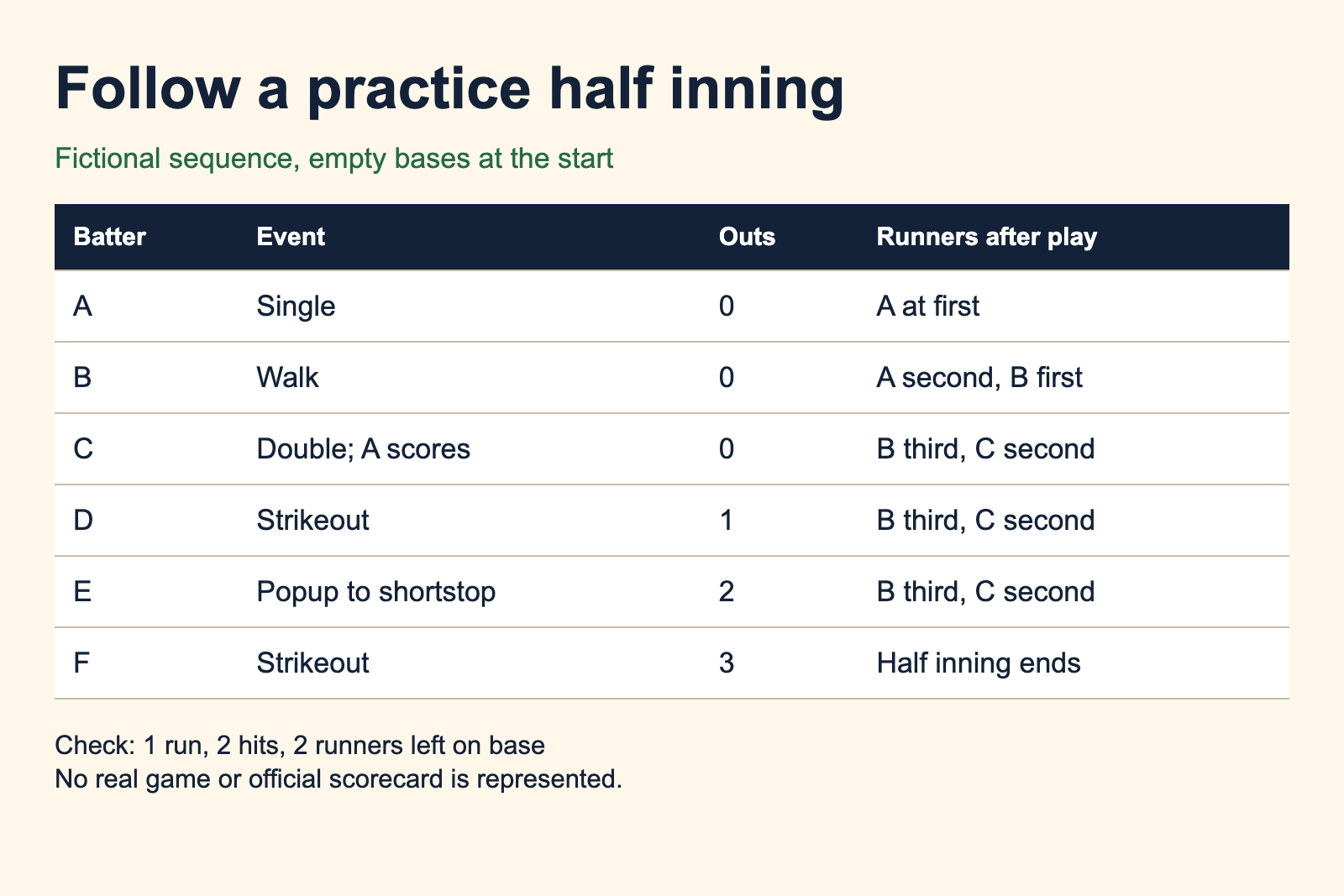
Batter A singles. Mark 1B in A’s box and show A at first. Batter B walks, so mark BB for B, advance A to second and show B at first. Neither event creates an out.
Batter C doubles. In this particular example, A scores and B stops at third. Mark 2B for C and show C at second. Update A’s path all the way home and B’s path to third. Do not move B home merely because a double was hit; record the advancement specified in the play.
Batter D strikes out for the first out. Batter E pops out to the shortstop for the second. Both runners stay where they are. Batter F then strikes out for the third out, ending this practice half inning.
The check is one run, two hits and two runners left on base. A scored. C’s double and A’s single were the hits. B remained at third and C at second. The walk put a runner aboard but did not add a hit.
Check the state after each event
Cover the next row of the example and explain the current situation aloud. Name the outs and occupied bases. Then reveal the next event and update your sheet. If you cannot explain the state, pause before adding more notation.
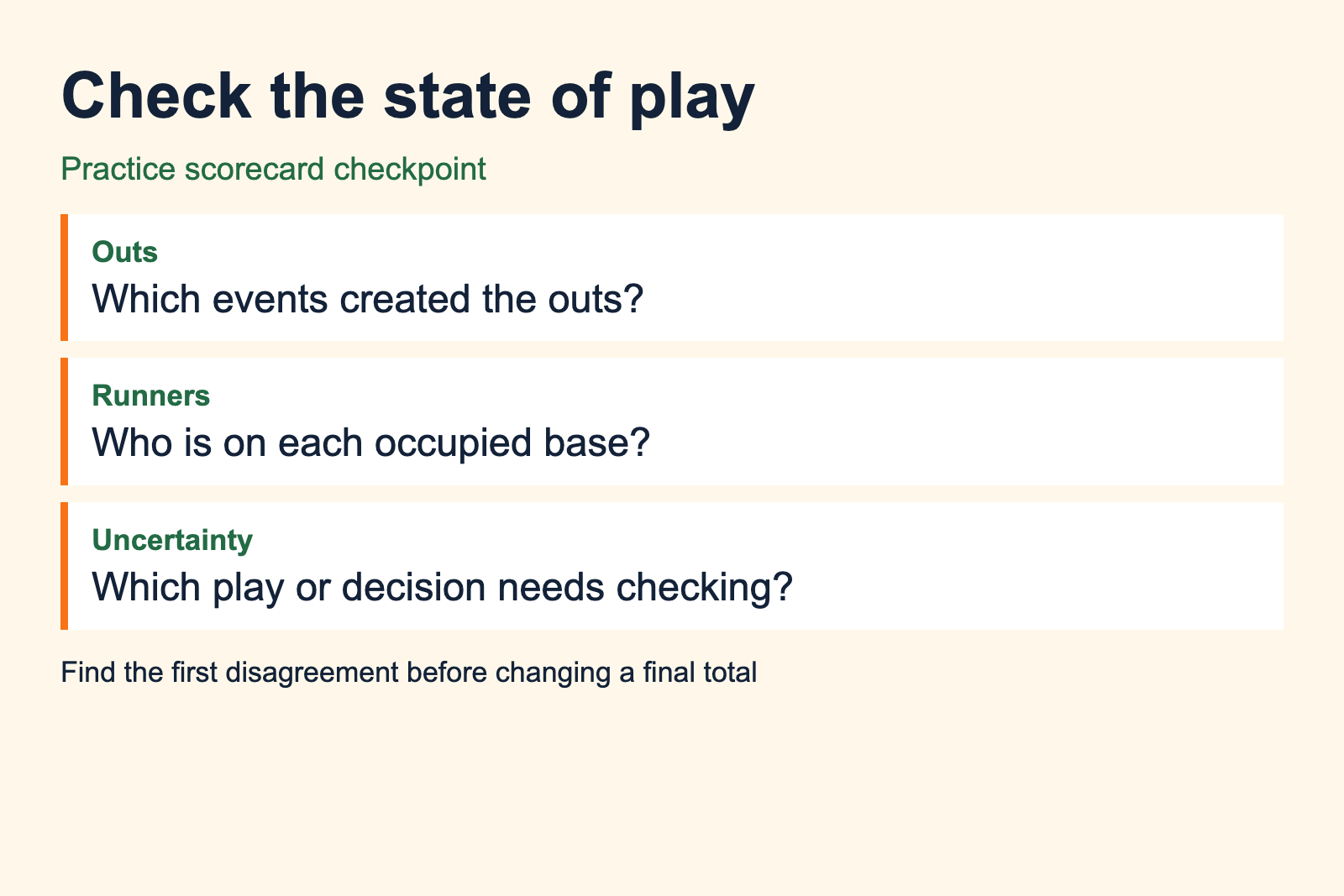
When a total disagrees, look for the first event where your sheet diverged from the sequence. A missed runner advance can make several later boxes look wrong. Correcting only the final total would hide the original mistake and leave an unreliable account.
For a real game, compare your running record with the official information available to you. If you missed a play, mark the gap and ask for a dependable account. Do not quietly fill the box with the outcome you expected to see.
Keep uncertain judgments separate
MLB’s glossary places error classification with the official scorer’s judgment. Keep your observation separate from that decision.
If a ball gets through a defender, note what you saw and wait for the scoring decision before treating your guess as an official hit or error. A clear temporary note is more useful than a confident abbreviation you later forget was uncertain.
Keep substitutions traceable too. Record when a new player enters the batting slot instead of erasing the original name. Your sheet should let you tell which player produced the earlier result and which player was in the game afterward.
Use the scorecard as reporting notes
A scorecard can help you locate the inning that needs a closer look. Before using a statistic in a published report, check it against the official result or another dependable record. Your practice book is a reporting aid, not independent confirmation of itself.
Use the sports article guide to turn that sequence into a clear account. If you are calling a game, the play-by-play practice guide explains keeping essential game information visible while you speak.
Save the scorecard with the story or call it supported. The portfolio workflow helps you explain that preparation alongside a finished sample.
Sources
- Little League University, The Basics of Scorekeeping, accessed September 2026. Stable notation guidance; current competition rules control official duties.
- Jacksonville Jumbo Shrimp, 2025 game program, printed page 29, How to Keep Score.
- MLB glossary, Error, accessed September 2026.