
Sports journalism is reporting about sport and the people, institutions and decisions around it. A game result can be the starting point. So can a change in training facilities, a team’s travel arrangements or a policy that affects who gets to participate.
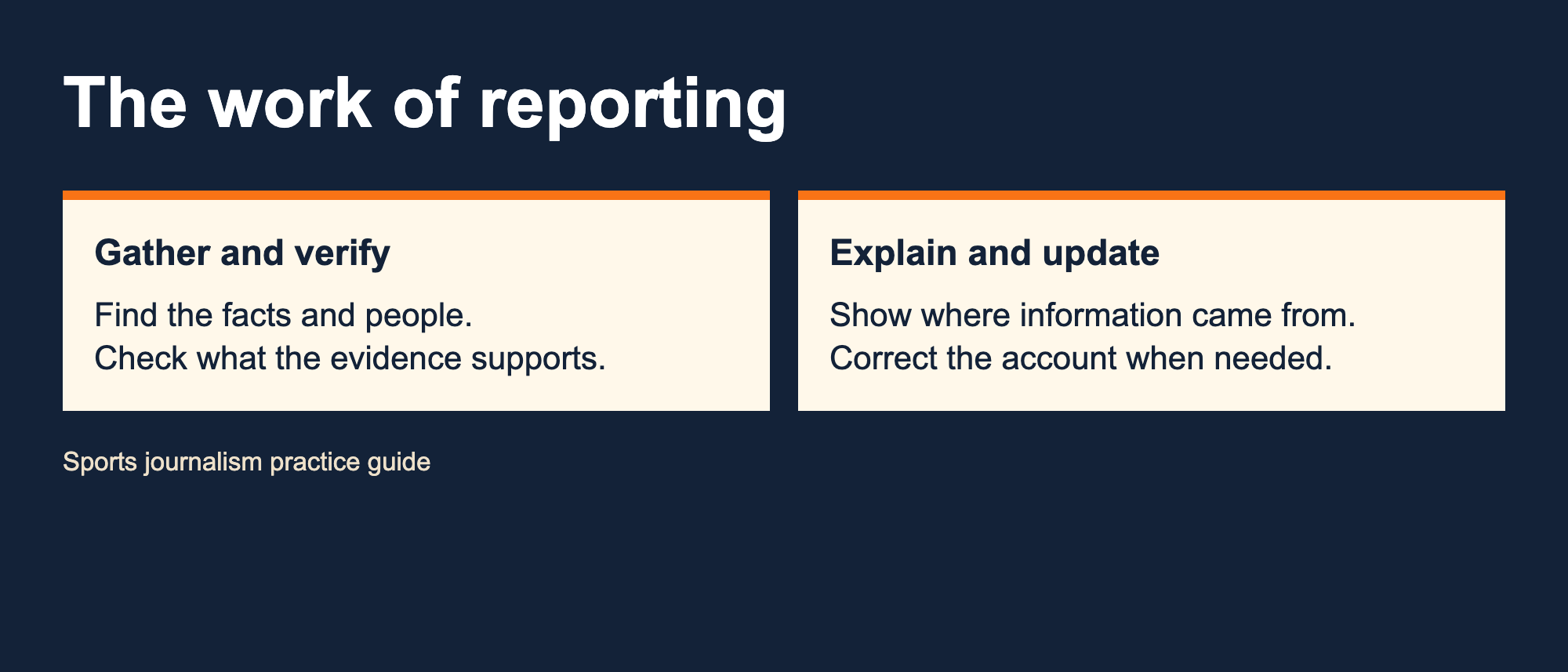
The work is recognizable by its methods: gather information, check it, explain where it came from and correct errors. A polished video or a lively opinion does not establish that reporting happened. Look for the evidence behind the account and the choices that shaped it.
The work behind the finished story
The Bureau of Labor Statistics describes reporters’ duties as including research, interviews, writing, accuracy checks and updates. It identifies sports as one subject reporters can specialize in. Those duties can produce an article, an audio report or a video package.
Much of that work stays out of the finished piece. A reporter checks the spelling of a reserve player’s name, compares a statement with a schedule and follows up when two accounts disagree. The audience sees the clear sentence that results, not every unsuccessful call or discarded paragraph.
A beginner can practice the same habits on a modest assignment. Cover an accessible event, record the source of each important fact and explain one development clearly. The scale of the audience does not change whether a quotation is accurate or a score has been checked.
Reporting, analysis and team communications
A reported story establishes what happened and provides supported context. Analysis interprets evidence to explain a pattern or make an argument. Opinion gives a clearly identified point of view. These forms can sit in the same publication, but readers should be able to tell which they are reading.
Team communications serves an organization’s own communication needs. A team announcement can be useful source material for an independent reporter. It still represents that organization’s account. An article that simply repeats it has not independently checked every claim or sought the perspectives the announcement leaves out.
Live commentary has another immediate job: help an audience follow and understand action. Our guide to color commentary explains the analyst’s role beside the main caller. A commentator can also do reporting, but the microphone or job title alone does not tell you how a claim was verified.
When considering your own work, name its purpose honestly. A personal reaction to a match can be an opinion piece. It should not be presented as an independently reported account if you have not done that reporting.
Independence affects ordinary choices
The Associated Press describes professional distance from the people it covers as part of its standards. In sports, the practical question is whether access, friendship or enthusiasm is deciding what you publish instead of the evidence.
Local sports publisher Joe Gisondi describes the pressure of covering rival schools whose readers sometimes expect a favorable account. His stated approach is to report relevant facts and explanations without demeaning young athletes. That is a useful example of judgment: an error can matter to a game’s outcome without justifying personal ridicule.
For a student reporter, independence can begin with telling an editor about a close connection to the subject. Let the editor decide whether to change the assignment or how to handle the conflict. Keep criticism specific, seek the relevant response and avoid making an athlete’s character stand in for evidence about a play.
Turn a sports topic into a reporting question
Consider a fictional practice assignment: a community club announces that its practice location will change next month. The announcement gives you a topic. Reporting starts when you identify what readers need to understand and where the answers could come from.
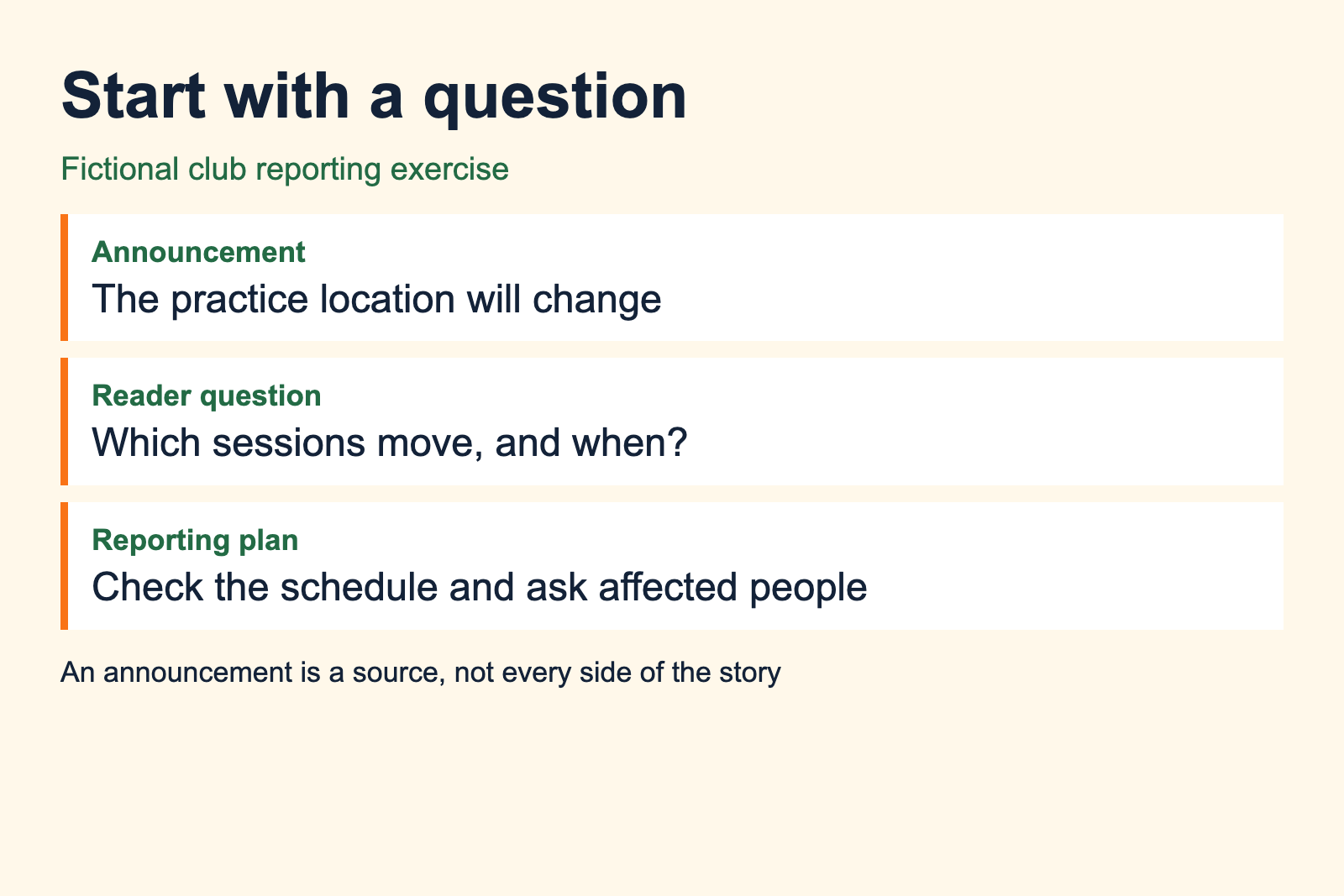
You could ask which sessions will move, when the change takes effect and how participants will reach the new location. The club can explain its decision. A current schedule can establish the published arrangements. Participants can describe their own expected difficulties, but their predictions should remain attributed expectations.
Do not begin with a conclusion such as “the move will ruin the season.” That turns an unanswered question into an allegation. Instead, collect the relevant accounts and records, identify any disagreement and give the decision-maker a chance to respond to specific concerns.
This exercise is invented. It makes no claim about a real club. Its purpose is to show how a story can concern sport without being a match recap or requiring access to a professional athlete.
Match each claim to the evidence
Different sources answer different questions. A published schedule can show what is scheduled. It does not prove that every session happened. A participant can describe what they experienced. One experience does not establish what happened to everyone.
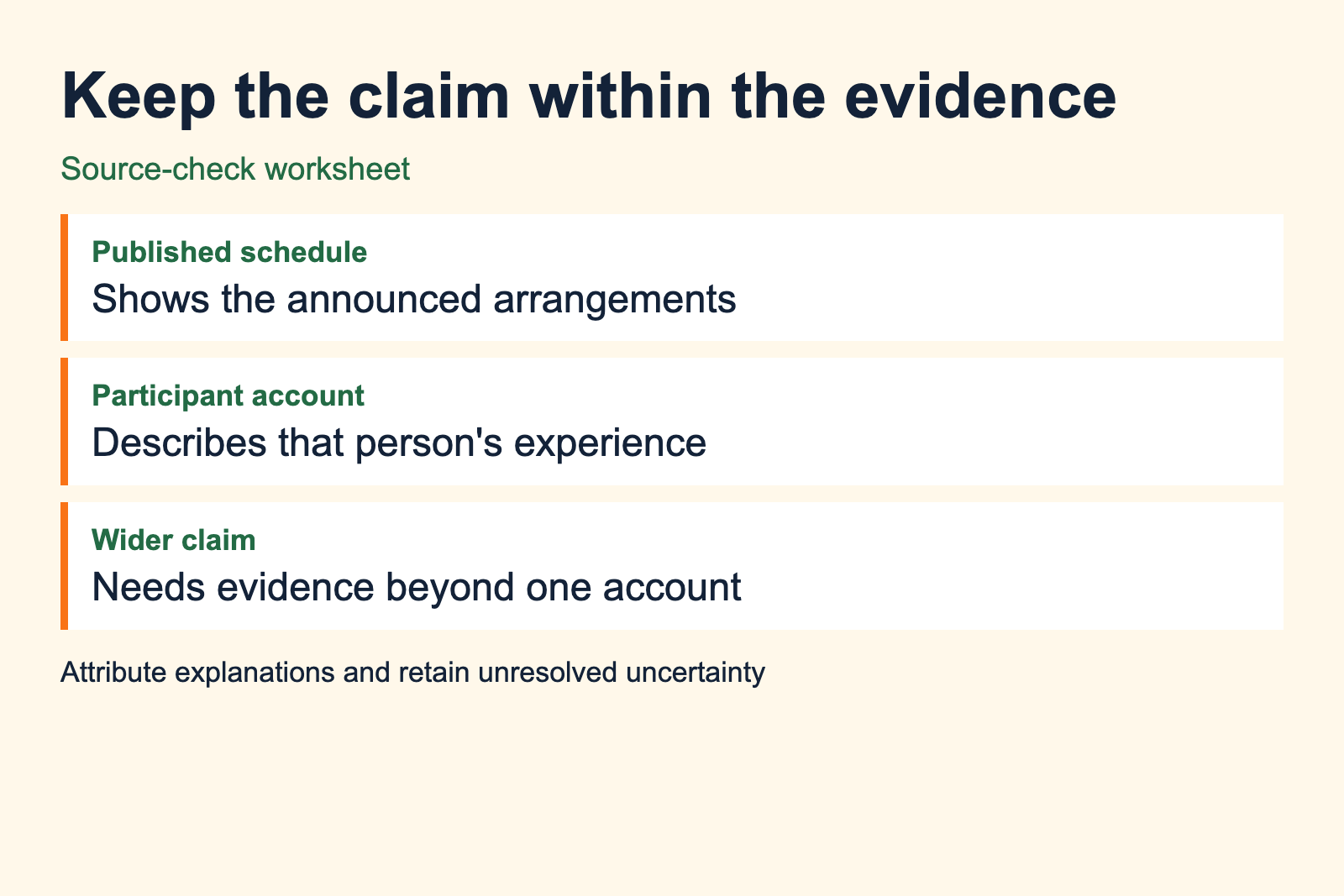
Before writing a broad sentence, ask whether your evidence is equally broad. If you have spoken with one participant, write about that person’s account with appropriate attribution. If you need to describe a wider pattern, do the additional reporting needed to support it.
Keep observation separate from inferred motive. You can describe a checked change in a lineup. You cannot know why a coach made it merely from watching the substitution. Ask, attribute the answer and retain any uncertainty the reporting does not resolve.
Try a small reporting assignment
Choose one event or decision you can investigate responsibly. Write down the central question, the sources you will approach and the factual details you need to confirm. Agree on access before arriving and follow the venue’s instructions while working.
Then use the sports article writing guide to turn checked notes into a draft. Ask an editor or instructor to review the evidence as well as the prose. A useful question is whether each important sentence is supported by the notes you retained.
A finished story can show how you applied verification and attribution. The portfolio guide helps you identify that evidence and describe your contribution.
Sources
- U.S. Bureau of Labor Statistics, News Analysts, Reporters, and Journalists, accessed September 2026.
- Associated Press, News Values and Principles, accessed September 2026.
- Joe Gisondi, Sports Media Field Guide, September 2022. Firsthand account of local sports coverage.