

Start with a broadcasting assignment you can complete, record and improve. A student radio shift, a supervised game production or a private practice call can give you evidence of what you can do. The next opportunity should give you a more specific responsibility or better feedback.
Becoming a sports broadcaster does not follow one required sequence. Education requirements vary, and production work can lead to a different job from the one you pictured. Choose a role, learn its duties and build samples that let someone assess those duties directly.
Choose the work you want to practice
“Sports broadcaster” can mean the person calling the action, an analyst explaining it, a studio presenter or a reporter delivering a story. Those jobs require different samples. A lively discussion of a game does not show that you can identify players and keep up with live action.
If play-by-play interests you, make a complete practice call and listen for accuracy and clarity. If you prefer presenting, prepare a short sports update from verified information. Keep the assignment narrow enough that you can finish it and ask someone to review it.
Try a production task as well when you have access to supervision. Seeing how a microphone feed, cue or recorded segment reaches the audience can help you understand what your colleagues need. Describe that experience honestly on your portfolio instead of calling every production assignment an announcing role.
Assess education by practice and feedback
The Bureau of Labor Statistics announcer profile says broadcast announcers and radio DJs typically need a bachelor’s degree in a related field. It also says some jobs are available to people with a high-school education. This is broad U.S. occupational guidance, not a rule that every sports employer follows.
Before choosing a course or program, ask what you will actually make. Can beginners join the station? Who assigns games? Will someone critique a complete recording? Request concrete examples of student work and the conditions for getting production access.
A Southern Utah University sports broadcasting syllabus, for example, combines practical recordings with critique. That illustrates a useful feature to look for: repeated work followed by specific feedback. It does not establish that one program is the best choice for you.
If you are already enrolled, learn the existing student-media process before spending money elsewhere. If you are outside college, look for a supervised community-media opportunity or a course whose access and feedback you can verify. Compare the actual cost and time commitment with what the option provides.
Read the duties behind the job title
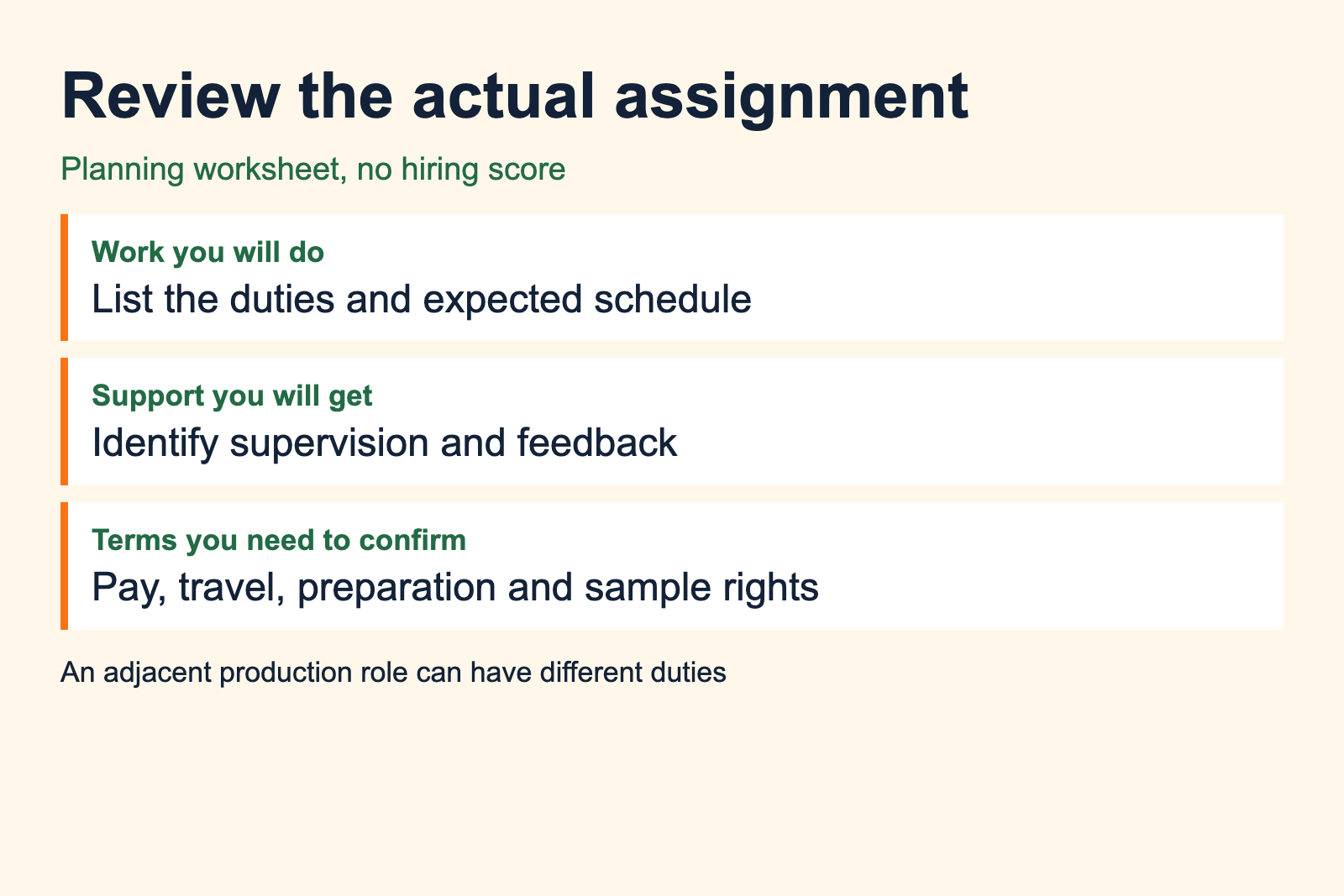
An adjacent job can teach valuable skills while involving little on-air work. The International Tennis Federation’s April 2025 production-assistant description includes production coordination, travel arrangements and media-rights administration. That is a historical example of a specific role, not a current vacancy or an announcing opportunity.
Use job descriptions to identify the tasks you would perform. Separate required experience from preferred experience. A title containing “assistant” does not establish that the employer expects a complete beginner, and working near a commentary position does not guarantee that you will eventually take it.
Ask who supervises the work and what training is available. Confirm pay, expected preparation, travel and the length of the assignment before accepting. BLS notes that announcing schedules can include nights and weekends, so compare the actual schedule with your other commitments.
Build samples that reveal your contribution
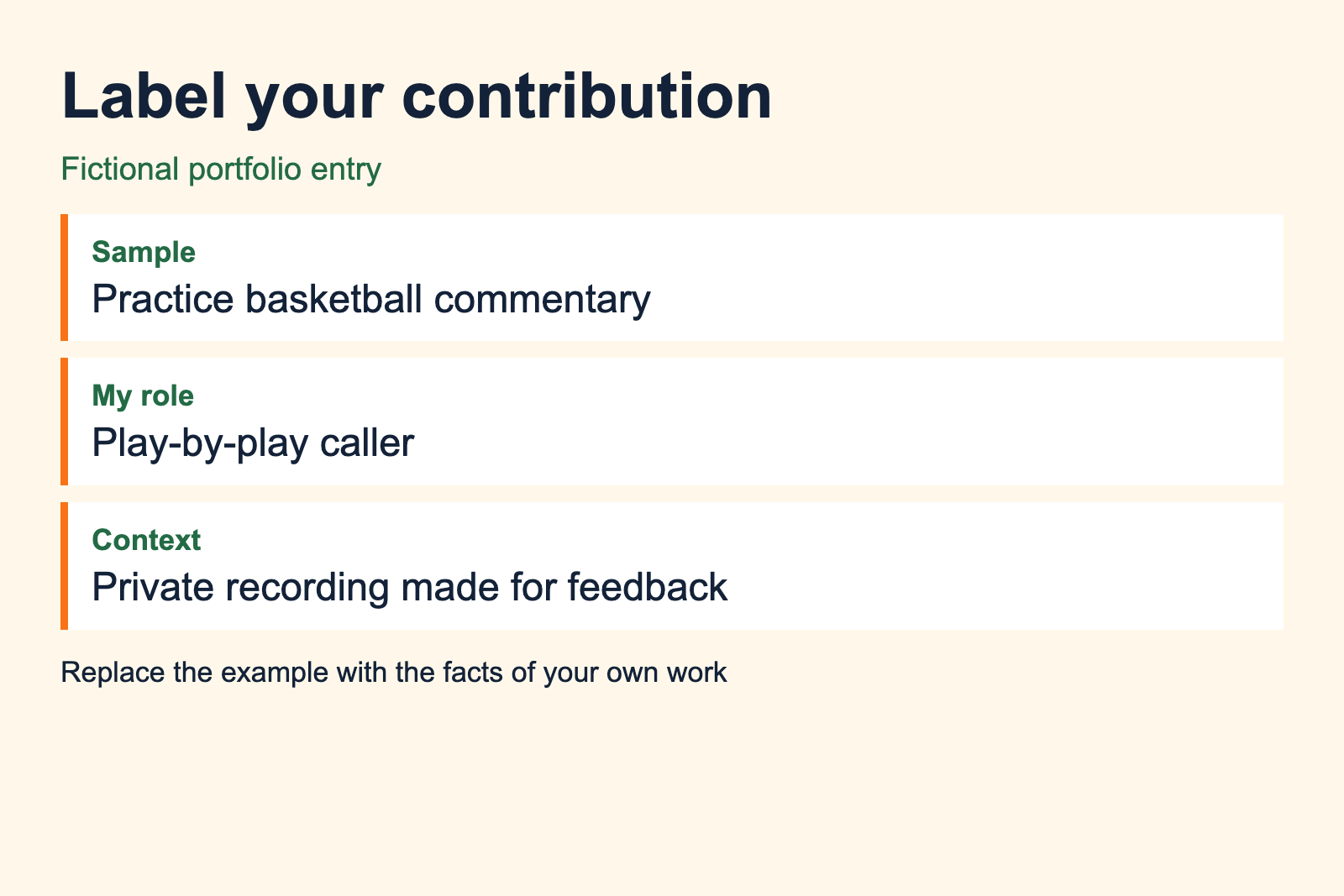
Keep full recordings of work you are allowed to retain. Note the date, sport and your role while those details are easy to remember. If a piece involved several people, identify exactly what you did: play-by-play, interview, edit or production support.
A simple label can do this without overstating experience: “Practice basketball call. My role: play-by-play. Recorded for review; not a live broadcast.” A real assignment should name the actual production and your contribution, subject to the organization’s permission to share it.
Make the listening task easy. Put the relevant sample near the top of your portfolio and tell the reviewer what it contains. Keep an accessible full segment available if they want to hear continuity beyond the strongest moment. Test the link while signed out so you notice accidental permission barriers.
Our complete commentary practice session takes you through the recording and file check. A technically clean sample lets a reviewer assess your delivery without first struggling to hear it.
Ask for feedback on one passage
Send a reviewer a clear request and a manageable sample when they have agreed to help. “At this point I lose the player identification; how would you organize the call?” gives them something to assess. Asking whether you are talented enough to work professionally is much harder to answer usefully from one clip.
Record the feedback beside the passage it concerns. Then make another attempt that addresses it. If you are told to give the listener more location, compare whether the next recording explains where the action happens before moving to background information.
Keep advice in context. A producer reviewing an audio-only call can want detail that a television viewer already has. Ask which audience and assignment the feedback assumes. You can then apply it to the work you intend to make.
Follow each application’s sample instructions
Jon Chelesnik’s collection of hiring-director advice records different preferences about demos. Some directors want short material; others want more variety and longer passages. The useful instruction is to follow the employer’s request instead of treating one reel length as a universal standard.
Read the posting again before sending anything. Match the requested file or link format, identify the relevant work and use a resume that makes your responsibilities clear. Check spelling, playback and contact details. If the posting specifies a submission channel, use it.
Track what you sent and when. Save the exact version of the sample so you know what an interviewer has heard. If you have no sample of a required skill, mark that as work to build rather than describing an unrelated clip as proof.
A practical first assignment plan
Choose one role and identify a way to practice it this week. Confirm access to the material or supervised production, prepare your notes, and make a complete recording. Ask for specific feedback, then repeat the part that needs work.
After that second attempt, write down what you can now show and what is still missing. Use that list to choose your next assignment, course or application. It gives you a concrete reason for the next step without assuming that every opportunity leads to the same career.
Compare the role and pay unit in an actual offer with the sports media careers and salary guide. For applications, assemble a demo reel that shows the work that role requires.
Sources and career context
- BLS, Announcers and DJs, updated August 27, 2026. Broad occupational guidance.
- STAA hiring-director advice, accessed September 2026. Reported preferences differ.
- ITF production-assistant description, April 2025. Historical duties example.
- SUU sports broadcasting syllabus, spring 2026. Educational example.