
Better sports photographs begin before you press the shutter. Learn what is likely to happen, inspect the background from your allowed position and keep watching after the main action. Then edit the session for pictures that explain the event, with captions you can verify.
These exercises focus on coverage and moment selection. If your photographs are consistently blurry or too dark, first work through the camera-settings guide. Once you can make usable frames, give your next practice session a specific observation task.
Learn the cues that come before the action
Photographer Jeff Swinger recommends homework on the sport in his Canon guide. Knowing the structure of the event helps you prepare for a moment instead of noticing it only after it has passed.
Watch a short passage without taking pictures. Note what happens immediately before the action you want. Where does the subject start? Which direction does the movement develop? What tells you that a pause is ending? Use the answers to prepare your framing.
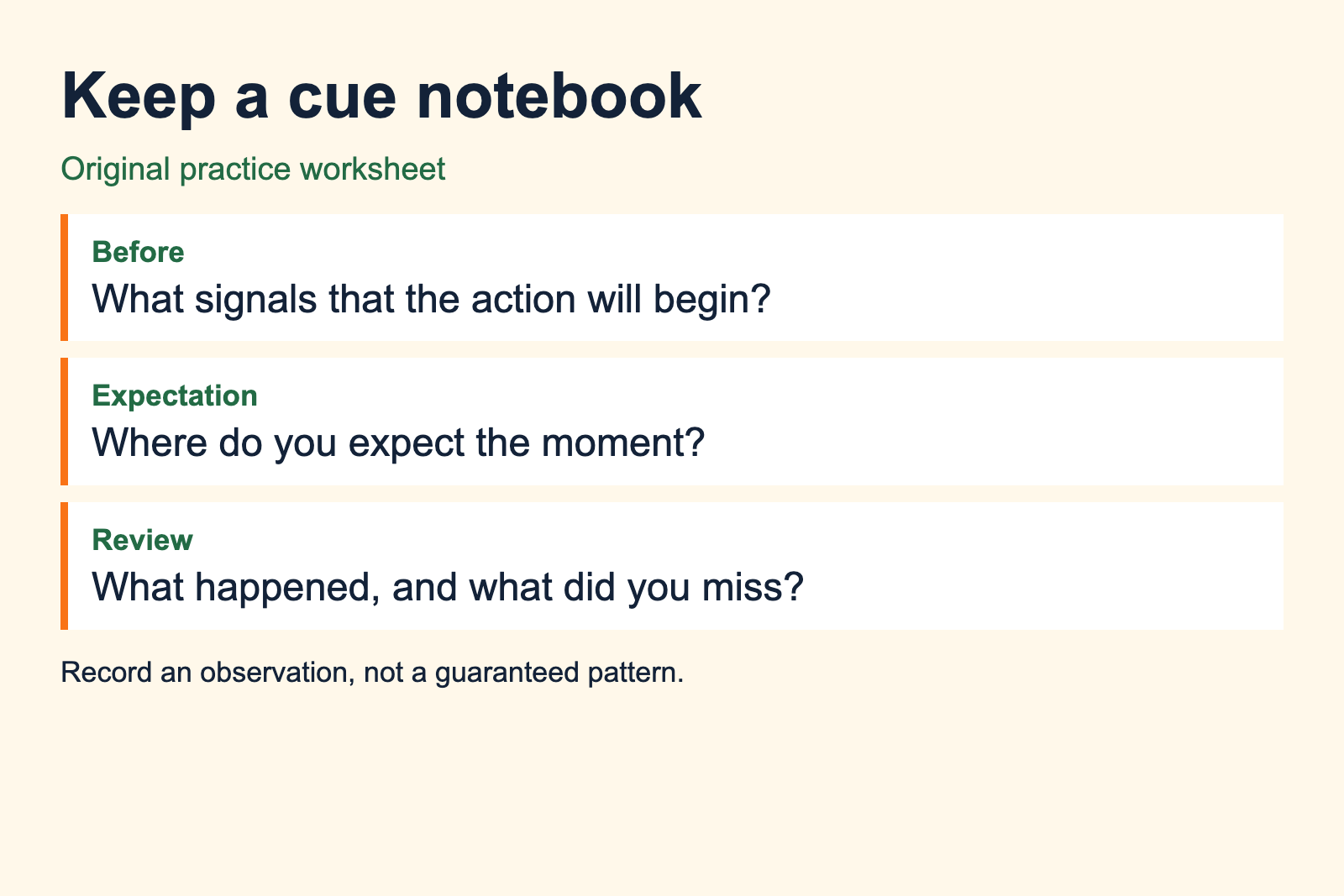
Make a cue notebook for practice. Write your expectation before a repeated situation, then record what actually happened. If the moment surprises you, identify which cue you missed. This is an exercise in observation, not a promise that play will follow a predictable script.
Inspect the background from your position
Nikon’s sports photography guide asks readers to look for clutter and consider whether another safe position would reduce distractions. Make that check before you spend a long stretch photographing the same distracting background.
Look through the frame from edge to edge. Notice objects that intersect the likely subject area or bright patches that pull your attention away. Compare another permitted view during a suitable break. Do not move into restricted space or disrupt someone else’s work to improve a composition.
A visible background can also explain where an event is happening. Decide whether it adds information or competes with the subject. The aim is an intentional frame, not a rule that every sports picture must have the same blurred backdrop.
Plan around the position you actually have
Nikon advises considering where the action occurs and notes that timing improves with practice. Turn that into a modest plan for your current viewpoint. Choose a type of moment you can see clearly instead of trying to copy a photograph made from an inaccessible angle.
At the start of a session, record the useful views and the obstructions. If a barrier hides part of the action, choose an observation goal that does not depend on seeing through it. Discuss a coverage gap with your editor when it matters to an assignment.
Stay aware of the activity around you, including during image review. Keep equipment out of movement routes and follow the event’s instructions. A position that prevents you from working safely is unsuitable even if it offers an attractive background.
Keep watching for the response
Swinger also emphasizes reactions after the action. The response to a decisive moment can explain its importance. Build time into your attention for what follows, rather than checking the screen immediately after every sequence.
For a practice review, place an action frame beside a frame from afterward. Ask what each one tells a reader. One could show the physical contest while the other adds a response. Keep both only if they contribute distinct information to the planned coverage.
Do not write an emotional interpretation as a verified fact just because an expression seems to suggest it. Describe what is visible and seek reporting for the context. The athlete interview guide can help you prepare a focused question when the assignment includes an interview.
Vary the information in the finished set
A long sequence often gives you several versions of one moment. Compare them closely, then choose the version that best serves the assignment. Keeping every near-duplicate makes the reader do the editing you could have done first.
Look for missing information. Does the set establish the setting? Can a reader understand the main event? Have you included useful context that is available from your permitted position? These questions concern the story, not a required number of wide shots or close-ups.
If all the selected pictures do the same job, identify a different observation task for the next session. You can improve coverage deliberately without rebuilding the entire equipment setup.
Protect the meaning during editing
The NPPA’s visual integrity standards require editing that preserves content and context. Apply the publication’s policy to your documentary work. Do not remove an inconvenient object or alter a scene to make the coverage appear different from what occurred.
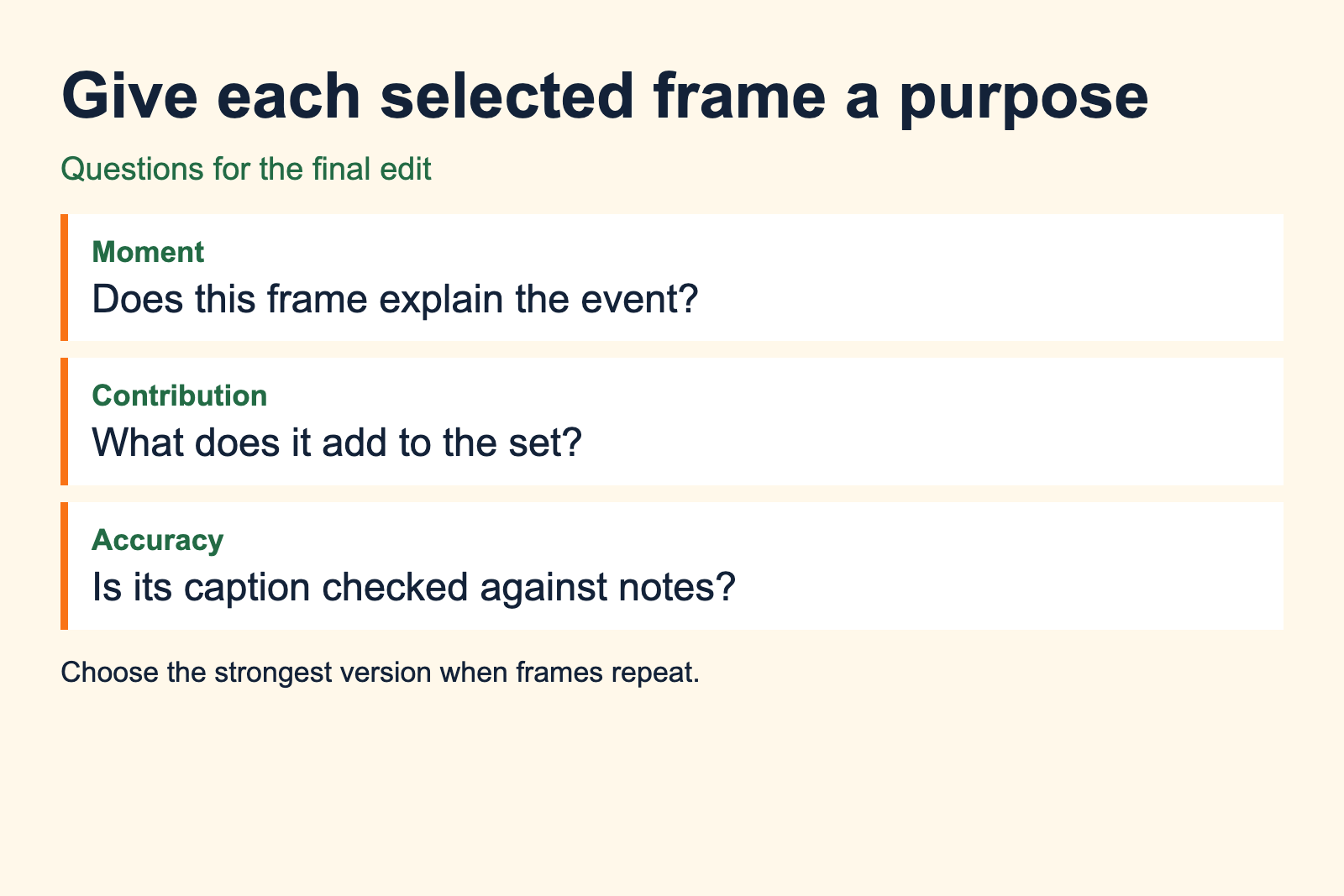
Check captions while editing rather than treating them as a final chore. Match names, dates and locations to your notes. If a caption contains background information outside the frame, confirm its source and make the attribution clear.
Keep an original file and a copy of the delivered version. When someone gives feedback, make sure you are both reviewing the same picture and caption. A correction is easier to handle when you can trace the published selection back to its source.
Choose one goal for the next session
Review the set and write a short diagnosis. Be precise: “I checked the display too soon and missed the response” gives you a practical habit to change. “I need better photos” gives you no starting point.
Bring that goal to your next permitted practice session. Record whether the change helped and what you still missed. Use the first-assignment guide when you are ready to turn those exercises into a complete edited package.
Review the assignment as a sequence before selecting a single favorite. The portfolio guide helps you choose photographs that show the skill a reviewer needs to assess.
Sources
- Jeff Swinger, Canon, Capturing From the Sidelines, June 1, 2018. Preparation, backgrounds and reactions.
- Nikon, Photographing Sports Indoors and Out, accessed September 2026. Position and timing guidance; older equipment settings excluded.
- NPPA, 2026 Best of Photojournalism guidelines, visual integrity section.